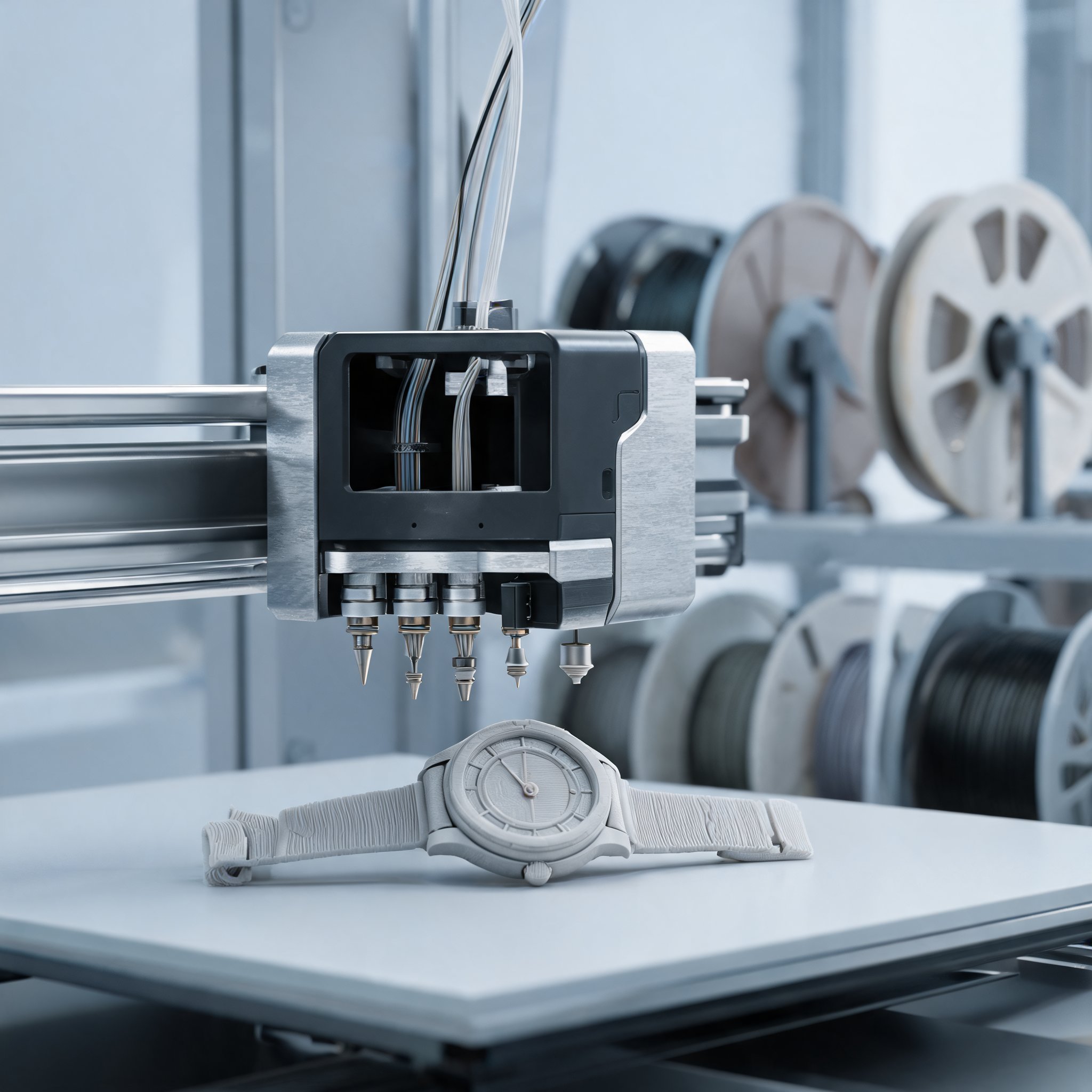
Bambu is previewing its upcoming H3C 3D printer one feature at a time. After teasing multi-color output, the company has turned to multi-nozzle and multi-filament compatibility with an image of a multi-component watch produced in three configurations.
The depicted print uses a 0.4 mm nozzle with 1.75 mm filament for the rigid case, a 0.2 mm nozzle with 1.75 mm filament for crisp details, and a 0.4 mm nozzle with 2.85 mm filament for what appears to be a soft TPU strap. The teaser does not provide full specifications.
Mixed nozzles in one job
Two implications stand out. Bambu appears to be preparing 2.85 mm filament support for soft, rubbery materials such as TPU. More significantly, the image suggests that 0.2 mm and 0.4 mm nozzles could be used within the same print.
That would address a long-standing user request. Bambu's existing H2D, H2C and newer X2D models have generally been limited to a single nozzle size per job, so users could not mix 0.4 mm and 0.2 mm nozzles. Software limits have been cited as the obstacle on current dual-nozzle machines. As a result, a job needing both fine detail and larger structural passes could not use both nozzle sizes in one job on those machines.
The example is designed to show how one job could combine a rigid housing, fine surface detail and a flexible strap. An update to the teaser shows watch components being printed in place as a single part with multiple nozzle and filament sizes.
The arrangement matters because the watch combines parts with different requirements: a structural case, fine cosmetic detail and a soft strap. In the teaser, nozzle diameter and filament diameter change according to those roles, rather than forcing the whole job through one setup.
Which printers will get it?
Bambu has not clarified whether mixed nozzle sizes will be available on all compatible printers or reserved for the upcoming flagship H3C and the smaller P3C. The P3C has not been formally announced, and the teaser does not explain whether it would share the same capabilities.
The commercial question is whether Bambu will use the feature to drive sales of new machines or extend it to existing customers. If limited to new models, owners of recent dual-nozzle machines may view it as a missed upgrade; if extended, it could change how those printers are used. Until specifications are released, the teaser should be treated as a preview of intended capability, not a confirmed shipping feature.