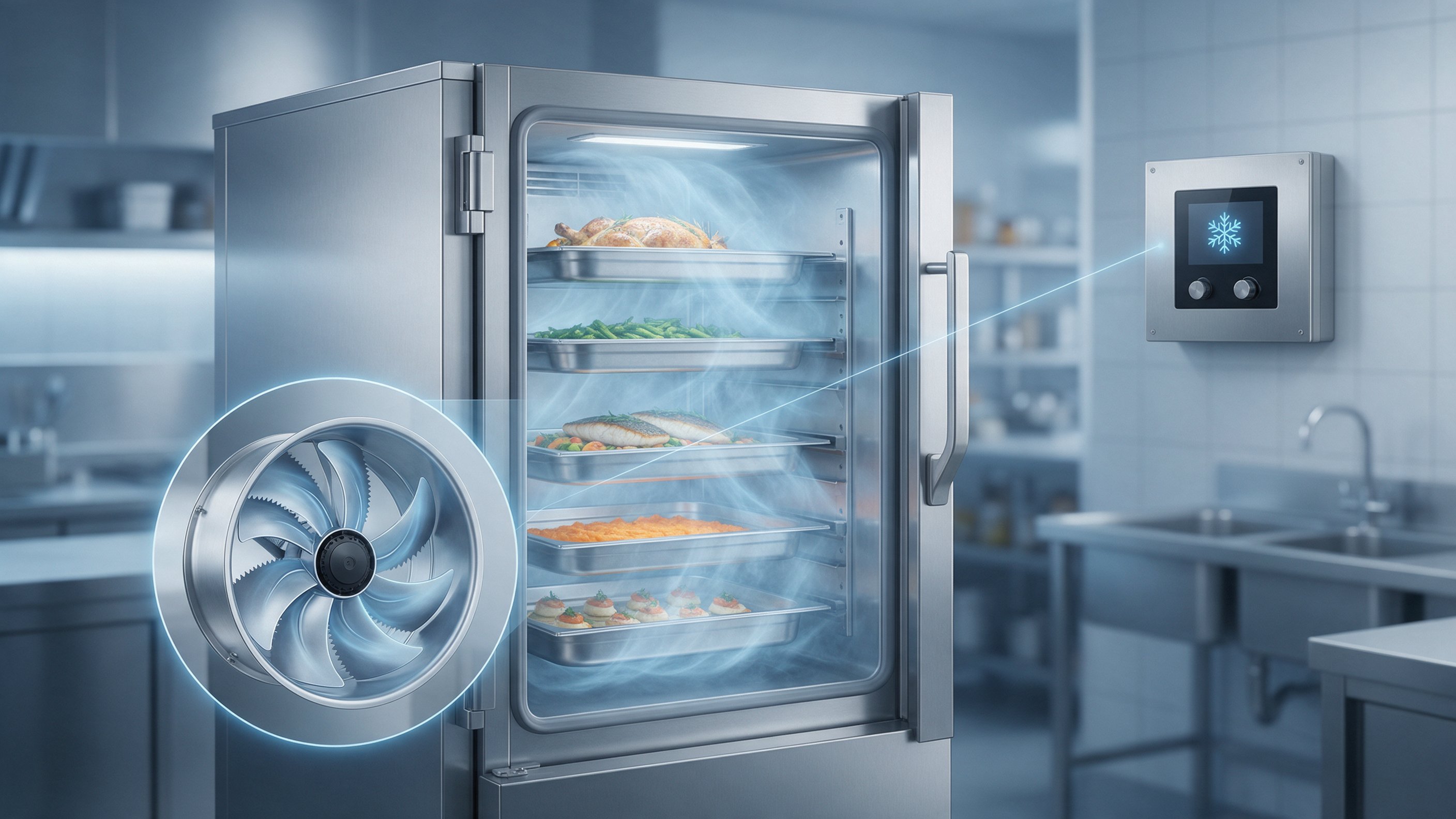
Professional refrigeration is being reshaped by three pressures at once: the need to guarantee food safety, rising energy costs and an evolving European regulatory framework. In an industry feature on the subject, blast chillers — equipment that rapidly lowers food temperatures through intensive cold-air circulation — are described as having moved from a specialised kitchen tool to a central element in optimising processes, improving food quality and building more efficient installations.
The function described is direct. Blast chillers circulate cold air around food to bring temperatures from above 70°C to below 3°C in as little as ninety minutes. The article ties this to the HACCP system, noting that the "danger zone" of roughly 63°C to 4°C is where microorganisms multiply fastest, and that shortening the time food spends in that range is a basic control principle. Beyond compliance, it says, rapid cooling limits bacterial growth, extends shelf life and helps preserve texture, moisture, aroma and nutritional value.
Airflow takes centre stage
Performance, the feature argues, depends less on the refrigeration circuit alone than on how uniformly cold air reaches the entire load. Areas of low air velocity or turbulence, it notes, leave parts of the product cooling more slowly, and the resulting temperature differences can affect safety, cooling times and final quality. On that basis the fan is presented no longer as a secondary component but as a key factor in overall efficiency.
Central to the argument is EC (electronically commutated) motor technology, which combines high electrical efficiency with continuous speed control so that airflow can be matched to each stage of cooling. Combined with biomimetic impeller design and composite materials, the article says, this yields more uniform cold-air distribution and lower energy use. It also cites reduced noise, lower heat generation, longer service life and fewer maintenance requirements, and notes that integrated controls can replace some external controllers, freeing space.
Digitalisation and smart management
Modern units, according to the feature, can select programs by food type, monitor temperatures through probes and record the full process for traceability — useful during food-safety audits. Open protocols such as Modbus allow integration into kitchen infrastructure and building management systems, supporting remote monitoring and predictive maintenance, where continuous analysis of temperatures, fan speeds, operating hours and energy use is used to catch deviations before they become failures.
The European regulatory backdrop
The article frames these developments against EU energy and carbon objectives. The Ecodesign framework, it says, is broadening beyond energy performance to include durability, repairability, digitalisation and system-level efficiency, with the Ecodesign for Sustainable Products Regulation (ESPR) described as a turning point. While many measures will arrive gradually, a 2026 horizon is already influencing manufacturers' and engineering firms' decisions. Performance gains, the feature adds, will depend not only on the refrigeration circuit but equally on motors, fans, heat exchangers and electronic systems.
Industry roles and a shared challenge
Ventilation specialist ZIEHL-ABEGG is cited as an example, with EC axial fans for commercial refrigeration and food service combining high-efficiency motors, optimised aerodynamics, low noise and open-protocol communication. More broadly, the article says manufacturers must keep investing in innovation to meet tightening rules, while installers will need deeper expertise in electronics, connectivity and control systems — positioning them as technology advisers rather than suppliers of cooling capacity alone.
The feature concludes that food safety remains the primary objective, but that meeting it will rely on an integrated approach in which energy efficiency, digitalisation and sustainability are treated as one concept — equipment that cools effectively with minimal energy use, greater connectivity and the flexibility to meet emerging regulatory and environmental demands.