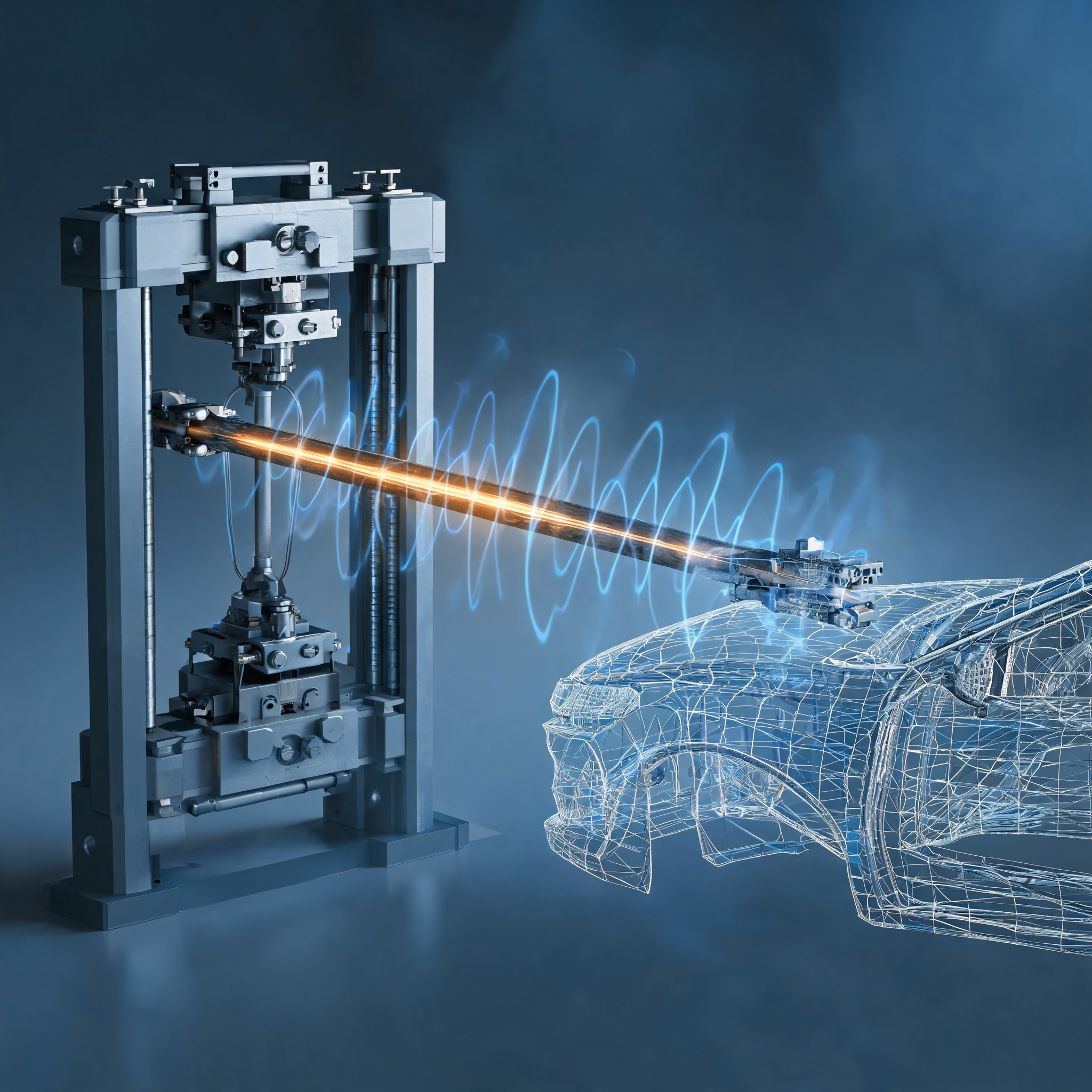
High strain rate testing machine manufacturer Instron is highlighting how dynamic material characterisation can give engineers more representative data for simulation, material selection and product development, arguing that the relevance of material data matters as much as its volume.
In an article attributed to Andrea Incardona, application engineer and product specialist at the company, Instron explains that many materials exhibit strain-rate-dependent properties, meaning their mechanical response can change as loading speed increases. A material characterised under quasi-static conditions may therefore respond differently when subjected to a rapid impact or crash event.
Study quantifies simulation gains
The article cites a 2025 study published in the SAE International Journal of Materials and Manufacturing, titled "Influence of Strain Rate Effect on Mechanical and Crashworthiness Properties of CFRP Composite Structures". According to Instron's account, incorporating strain-rate-dependent material properties into crash simulations reduced discrepancies between simulated and experimental results: the discrepancy in peak acceleration fell by 6.5 per cent, while mean acceleration and displacement discrepancies fell by 5.9 and 6.3 per cent respectively.
On that basis, the article argues that capturing how a material responds as loading becomes faster can give engineers a more representative basis for simulation than conventional data alone.
Capturing behaviour across loading rates
Depending on the specimen, materials can be characterised from quasi-static conditions up to strain rates approaching 1,000/s, with the achievable range set by the material, specimen geometry and test method. Tests can last just 3 to 10 milliseconds, requiring data acquisition capable of capturing the material response over a very short period. If strength, stiffness, deformation mechanisms or failure behaviour change as strain rate rises, relying solely on conventional data could leave a model unable to represent the conditions experienced during a rapid event, the article notes.
Material selection and weight trade-offs
Conventional properties such as strength and stiffness are important but do not necessarily show how a material will respond when loading becomes rapid. Two materials that appear comparable under conventional testing may behave differently under high strain rate conditions. Characterising their dynamic behaviour allows engineers to consider how each material deforms, absorbs energy and ultimately fails under conditions relevant to the application, which becomes particularly important where performance must be balanced against weight.
The article points to automotive crash structures and aerospace components as examples where understanding dynamic material behaviour can inform decisions about both material selection and component design.
Data capture in the development loop
Instron describes a development process in which material behaviour is measured, incorporated into simulation, used to compare design options and then validated through physical testing, positioning testing as more than a final check on an existing design. Engineers can use dynamic data earlier to assess whether a material is suitable, refine a component design and understand how changes may affect performance.
For data capture, the company says its high strain rate testing systems support acquisition at up to 200 kHz, while digital image correlation (DIC) can provide additional information about strain development across the specimen; analysis tools then support data processing and theoretical modelling.
- Strain-rate-dependent behaviour can alter strength, stiffness, deformation mechanisms and failure.
- Characterisation ranges approach 1,000/s, with individual tests lasting 3 to 10 milliseconds.
- Instron systems acquire data at up to 200 kHz, with DIC available for strain mapping.
The article's conclusion is that material data is only as useful as its relevance to the conditions a component will face, and that revealing how materials respond to rapid loading gives engineers a more complete picture of performance from simulation through to product development.