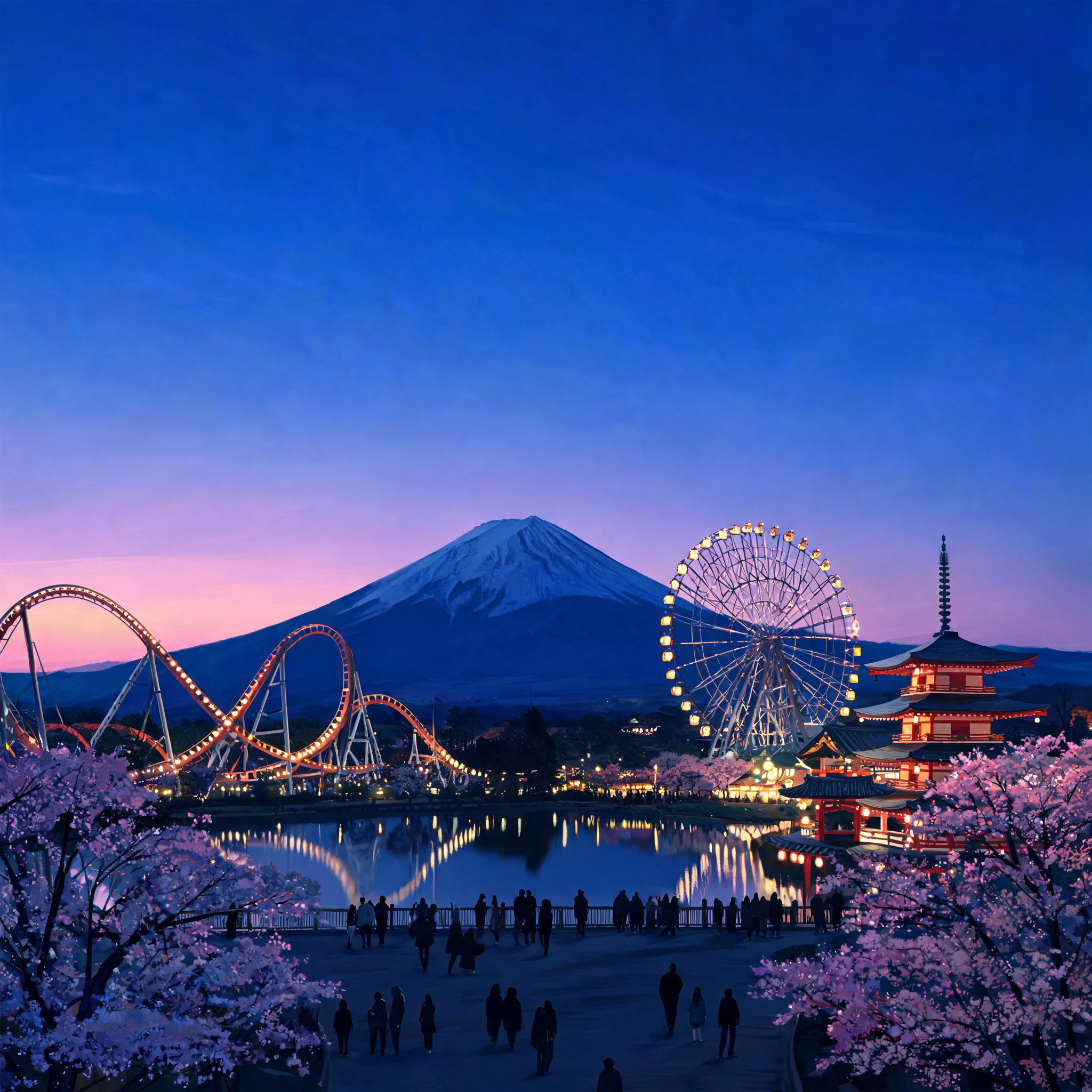
Japan’s theme park sector is expanding on several fronts at once. The country welcomed a record 42.7 million international visitors in 2025 and remains one of the world’s most popular travel destinations, with theme parks drawing millions of visitors each year. The 18 parks in this roundup show that growth is not limited to a single operator, city or ride type.
Tokyo and Osaka remain the anchor markets
Tokyo Disneyland, which opened on 15 April 1983, was the first Disney theme park outside the United States. It is based on the original Disneyland in California and has seven themed lands: World Bazaar, Adventureland, Westernland, Fantasyland, Tomorrowland, Critter Country and Toontown. Tokyo Disneyland and Tokyo DisneySea are owned and operated by the Oriental Land Company under licence from The Walt Disney Company, making them the only Disney parks in the world not owned by Disney. In 2026, Tokyo Disneyland announced Space Mountain Earthrise and Sugar Rush: Sweet Rescue as part of Tomorrowland’s 100 billion yen ($630 million) transformation. The new Space Mountain is set to replace the original coaster in 2027.
Tokyo DisneySea opened in September 2001, spans 49 hectares and is divided into seven themed ports, including Mediterranean Harbor, American Waterfront, Arabian Coast, Mermaid Lagoon, Lost River Delta, Port Discovery and Mysterious Island. In 2024, the resort opened Fantasy Springs, its largest expansion to date. The $2.2 billion project introduces worlds inspired by Frozen, Tangled and Peter Pan, with landmarks such as Arendelle Castle, Rapunzel’s Tower and Neverland.
Universal Studios Japan in Osaka opened in 2001 and features lands and attractions based on Harry Potter, Jurassic Park and Minions. It became the first Universal park in the world to open Super Nintendo World in 2021, and in 2024 it opened the world’s first Donkey Kong Country area within that land. In 2026, Universal Studios Japan announced its first expansion since 2001, with plans to invest up to 300 billion yen in new attractions across 60,000 square metres of nearby land.
IP strategies blend permanent lands with limited-time events
Universal Studios Japan hosts limited-time collaborations featuring Demon Slayer, Jujutsu Kaisen, Pokémon, One Piece and Resident Evil, and has welcomed Sanrio characters through seasonal shows, parades and limited-time entertainment. Fuji-Q Highland runs limited-time collaborations with anime franchises including Demon Slayer, Evangelion, Gundam and Pokémon. Hirakata Park frequently collaborates with Japanese IPs and characters such as Sanrio, Gintama, Sumikko Gurashi, Ultraman and Super Sentai. The pattern suggests that parks use temporary events to test and refresh demand alongside permanent themed areas.
Immersive, non-thrill parks build distinct identities
Ghibli Park, within the Expo 2005 Aichi Commemorative Park, brings Studio Ghibli films to life across five themed areas. It opened in November 2022 with Ghibli’s Grand Warehouse, Dondoko Forest and Hill of Youth, then added Mononoke Village in November 2023 and Valley of Witches in March 2024. It has no major thrill rides or roller coasters, but highlights include a large-scale recreation of Howl’s Moving Castle, a My Neighbor Totoro-themed playground with a replica of Satsuki and Mei’s House, and Catbus electric vehicles. In 2026, the park announced plans for a new indoor area inspired by the 1984 film Nausicaä of the Valley of the Wind.
Moominvalley Park opened in March 2019 in Hanno, Saitama Prefecture, as part of the wider Metsä complex. It is the second Moomin-themed park in the world, after Moomin World in Finland, and the first outside the characters’ home country. It recreates the world of the Moomins across four main areas: Hajimari no Irie, Moominvalley, Kokemus and Osabishiyama, with Finnish-inspired elements throughout.
Edo Wonderland Nikko Edomura in Tochigi recreates a town from Japan’s Edo period across 49.5 hectares, with traditional buildings and landmarks based on the Genroku era. Visitors can dress as samurai, ninjas or townspeople, while staff in period costumes interact with guests. The park offers theatre shows, ninja performances, street entertainment, parades, ninja training, archery and shuriken throwing, and it has film studios and sets used for historical Japanese films and television dramas.
Sanrio Puroland in Tokyo opened in 1990 and is an indoor park featuring Hello Kitty, My Melody and Cinnamoroll. Highlights include the Sanrio Character Boat Ride and My Melody & Kuromi Mymerroad Drive, plus themed restaurants, cafés and shops. In 2024, Alterface created Cinnamoroll’s Little Big Adventure for the park’s Discovery Theatre, featuring synchronised theatres, interactive gameplay and special effects. Asakusa Hanayashiki, established in 1853, is considered Japan’s oldest amusement park; it began as a botanical garden and evolved into a ride-based park in the 1940s. It features Japan’s oldest surviving roller coaster, built in 1953.
Regional resorts and roller coasters widen the map
Huis Ten Bosch in Sasebo, Nagasaki Prefecture, opened in 1992 and recreates a European-style Dutch town. Spanning about 152 hectares, it is Japan’s largest theme park by area and features canals, windmills, gardens, historic-style buildings, seasonal events, immersive attractions and large-scale illuminations. In 2025, working with Brogent Technologies, it opened Japan’s first premium flying theatre, with an 8K LED dome screen. Its Miffy connection dates back to 2011 and now includes themed shops, cafés, hotel rooms and events, plus the world’s only Miffy area, Miffy Wonder Square, which opened in 2025.
Nagashima Spa Land in Kuwana, Mie Prefecture, opened in 1966 and has 13 operating roller coasters, more than any other amusement park in Japan. Its collection includes Steel Dragon 2000, which ranks among the world’s longest roller coasters. The wider Nagashima Resort combines thrill rides with family attractions, a giant water park, hot springs, shopping and seasonal events, and is home to Nabana no Sato, a flower park known for winter illuminations. Fuji-Q Highland, opened in 1968 near Mount Fuji, features Fujiyama, Eejanaika and Takabisha, alongside family attractions and anime-themed experiences.
Yomiuriland in Tokyo’s Tama Hills has more than 40 rides and attractions, including the Bandit roller coaster, which reaches speeds of up to 110 km/h, and Goodjoba!!, an area inspired by Japanese manufacturing and everyday products. It attracted around 2.4 million visitors in 2024 and celebrated its 60th anniversary that year, having welcomed more than 70 million visitors since opening. Greenland in Arao City, Kumamoto, has around 80 attractions, a 105m-high Rainbow Ferris wheel and roller coasters including the suspended NIO and Milky Way, a dual-track coaster with seated and standing options. Sanrio Harmonyland in Hiji, Oita Prefecture, is the outdoor sister park to Puroland and offers stage shows, parades, two roller coasters, a Ferris wheel, a carousel, go-karts and a Sanrio-themed boat ride. In 2026, it opened Nakayoku Lab, which includes Sky Pal Collection, an immersive AR experience, and an AI voice-guided tour.
Legoland Japan opened in Nagoya in April 2017 as the first Legoland park in Japan and the second in Asia, after Legoland Malaysia. It became Legoland Japan Resort in 2018 and is operated by Merlin Entertainments. Its Miniland Japan recreates famous Japanese landmarks using more than 10 million Lego bricks, with moving trains, boats and animated scenes, and the park includes the interactive Lego Ninjago World. Hirakata Park, Osaka’s oldest amusement park, dates back to 1910, attracts around 1.3 million visitors a year and has 45 attractions, including the 696m-long wooden coaster Elf and the 1.3km-long Red Falcon, which reaches speeds of 70 kilometres.
The 2026 pipeline and its limits
PokéPark Kanto, the world’s first permanent outdoor Pokémon attraction, opened in February 2026 at Yomiuriland in Tokyo. The 26,000-square-metre park features more than 600 Pokémon across Pokémon Forest and Sedge Town, plus a Pokémon parade and two attractions, Pika Pika Paradise and Vee Vee Voyage. Its tickets include admission to Yomiuriland, although the amusement park’s rides require separate tickets.
Across the market, several major changes are announced rather than completed: Universal Studios Japan’s expansion, Tokyo Disneyland’s Tomorrowland transformation, Ghibli Park’s Nausicaä-inspired indoor area, and Harmonyland’s Nakayoku Lab. The source material also shows a mix of ownership and operating models, from Oriental Land Company’s licensed Disney parks to Merlin Entertainments’ Legoland Japan and Greenland Resort’s operation of Greenland. The sector’s next phase will depend on whether these investments move from plans to operating attractions and whether the record international visitor flow continues to support regional as well as metropolitan parks.