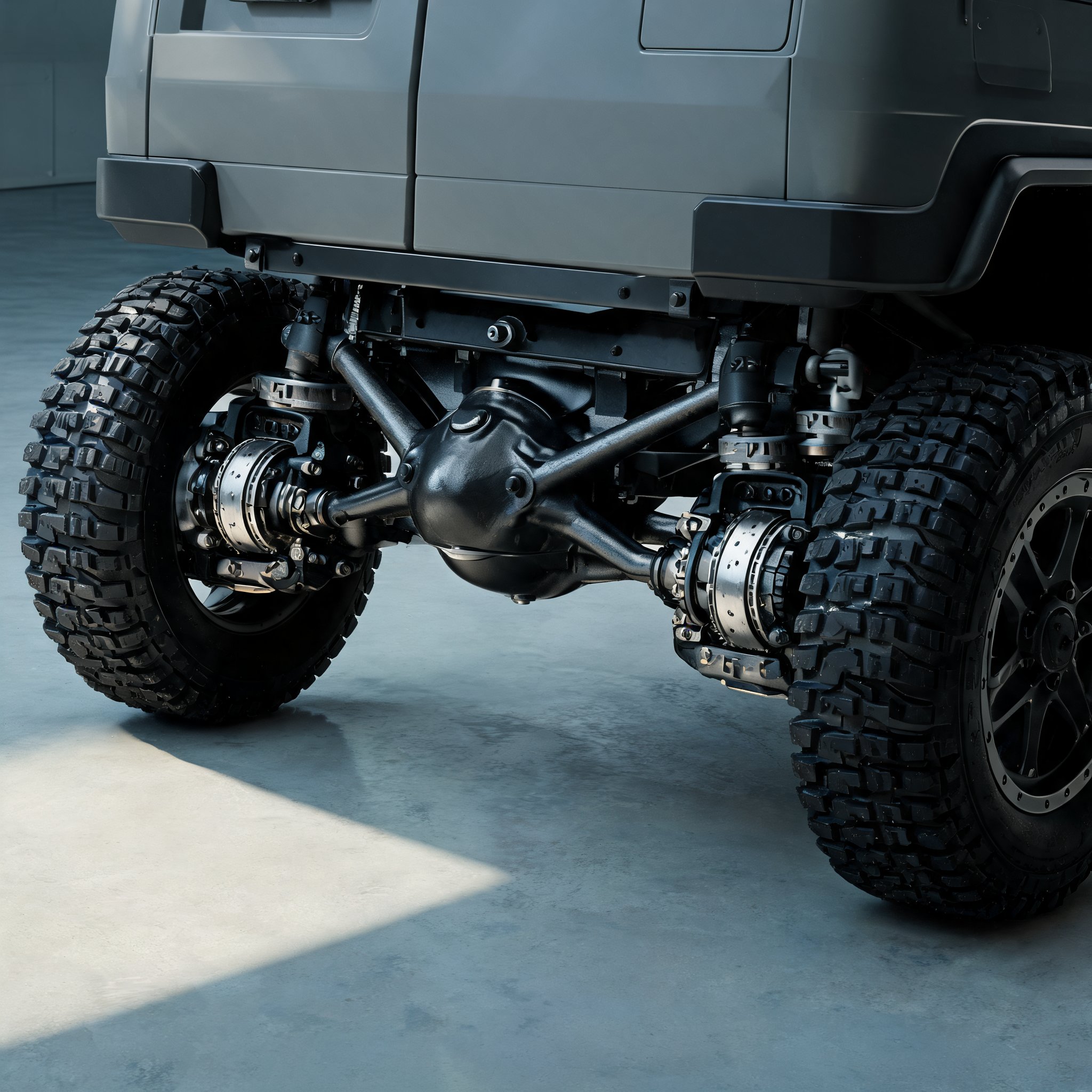
A custom Jeep XJ build by Zeph Gage shows how a rear-only portal axle can add off-road clearance at a fraction of the usual cost. Rather than buying a complete portal axle set, Gage combined a Ford 9-inch axle housing, geared hubs from a Humvee and HMMWV portal adapters from Jesse Haines Fabrication. The resulting rear axle costs about one-fifth of the roughly $20,000 typical portal axle sets from companies such as 74Weld.
Portal axles place a stack of gears behind each driven wheel. That layout lets the axle shafts sit higher and leaves less hardware hanging below the frame, so tall tires can produce more ground clearance. The concept is simple, but complete portal axle systems are expensive. Gage’s project focuses on the rear axle and uses a two-gear Humvee-style portal, a design that reverses the rotation of the input shaft.
Portal axle sets are prized for their ability to raise a vehicle’s drivetrain and improve obstacle clearance. They are used on hardcore four-wheelers in terrain such as Moab slickrock and Icelandic volcanoes, where clearance matters.
To make that reversed rotation work with a Ford 9-inch, Gage flipped the differential upside down so the driveline spins in the correct direction. A Yukon Gear and Axle third member is bolted to the differential. The arrangement turns low-pinion parts into what functions as a budget high-pinion unit. It adds about six inches of clearance, retains full shock travel and reduces stress on the differential; the build is expected to be effectively bulletproof as a result.
Installing a portal only at the rear is deliberate. Gage kept the front solid axle, avoiding the packaging constraints that can arise when adding portals to a vehicle that never had them from the factory. That choice also lets him avoid restricting shock travel and keeps ride height from rising excessively. The rear-only approach is a common trick in remote-control rock crawler builds.
The conversion is not an off-the-shelf kit. Gage fabricated homemade brackets and custom-tapped plates. He also used a two-piece brake rotor paired with a Ford Fusion caliper. The Fusion hardware was chosen partly because it offers an integrated electric emergency brake solenoid and helps with clearance.
The finished XJ can drive over a five-gallon bucket and still have several inches of spare clearance. That means the rear end is less likely to get hung up on obstacles that the front end can steer around. The build required considerable custom work, including attention to matching front and rear gearing, but it offers a lower-cost route to portal-axle capability on a rear axle.