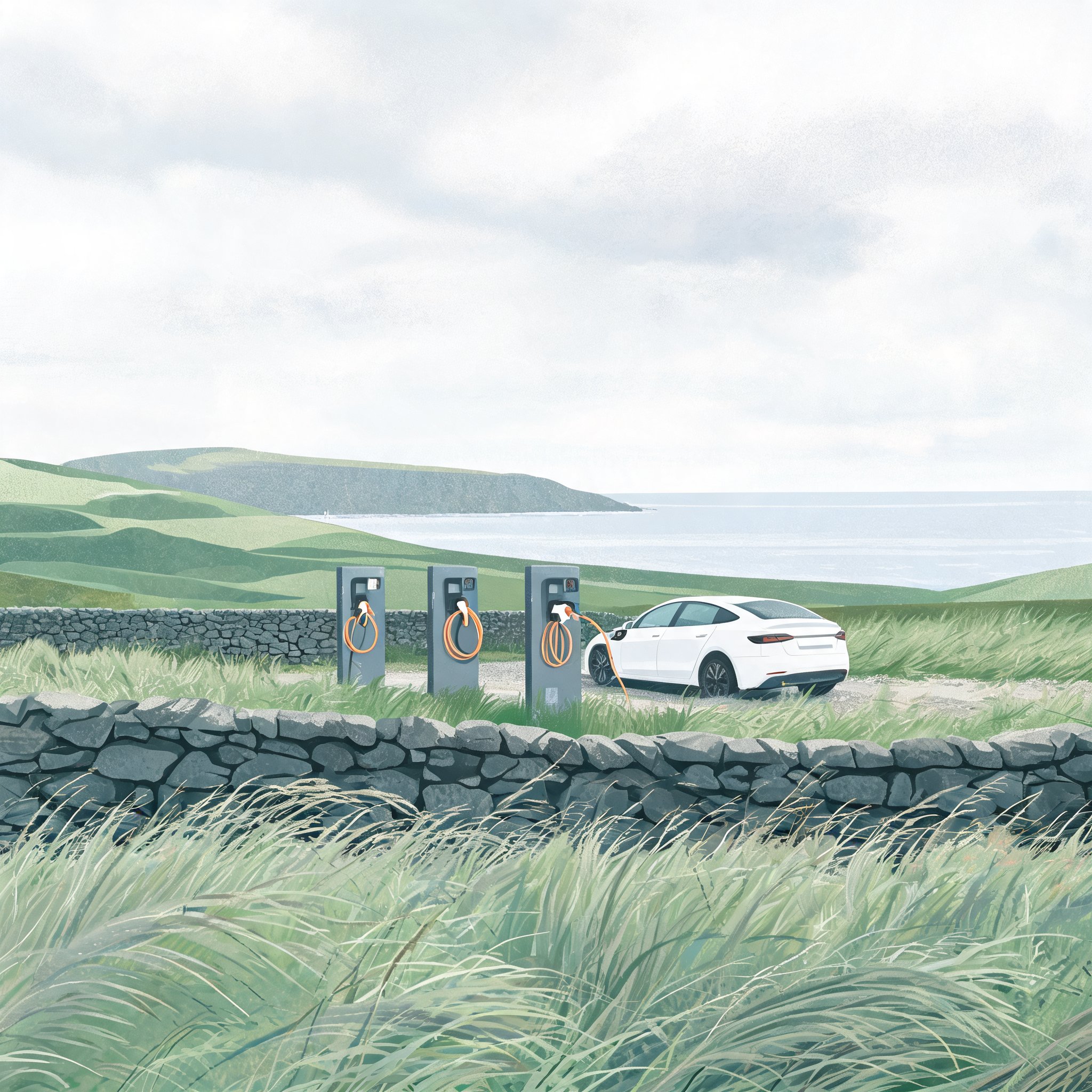
Northumberland County Council has passed a motion to add 36 electric vehicle charging points at 26 locations, expanding the public charging network it already operates. The sites will be spread across the county in northeast England, a coastal and rural area that borders Scotland and is known for Hadrian’s Wall and Northumberland National Park.
The council said 78 per cent of the new charge points will be installed on land it owns. The remaining chargers will be located on land owned by third parties through licensing agreements. The approach combines council-owned sites with licensed locations, extending the network beyond property controlled directly by the local authority. The 36 points are additions to the council’s existing network rather than a standalone new system. The announcement did not identify the individual locations, the power ratings of the equipment or a site-by-site construction schedule.
Just over £1 million in external funding from the City Region Sustainable Transport Settlement will finance the charging infrastructure. Revenue generated by the chargers will be used to meet their running costs, management and maintenance. The arrangement separates capital funding from operating costs: external funding finances the infrastructure, while charger revenue supports running costs, management and maintenance. The funding is intended to support the rollout of the charge points until 2029, according to the council.
Northumberland County Council has an in-house EV team that will handle both the installation and maintenance of the chargers. Richard Wearmouth, the cabinet member with responsibility for transport, said it was good to see more investment in EV charging provision. He noted that the county has one of the largest road networks in the country and said it was vital to ensure the necessary facilities are available to help people get around.
The additional charge points are part of a broader move toward lower-emission transport in the region. Separately, 14 BYD BD11 battery-electric buses entered service in Northumberland a few months before the charging announcement. The two measures are distinct, but both add to the infrastructure and vehicles available for electric transport in the county.
For drivers, the expansion will increase the number of public charging locations in a large, partly rural county where travel distances can be significant. The practical effect will depend on where the 26 sites are placed, what charging speeds are installed and how quickly the rollout proceeds between now and 2029. No completion date for all 36 chargers was given; the funding horizon runs to 2029.