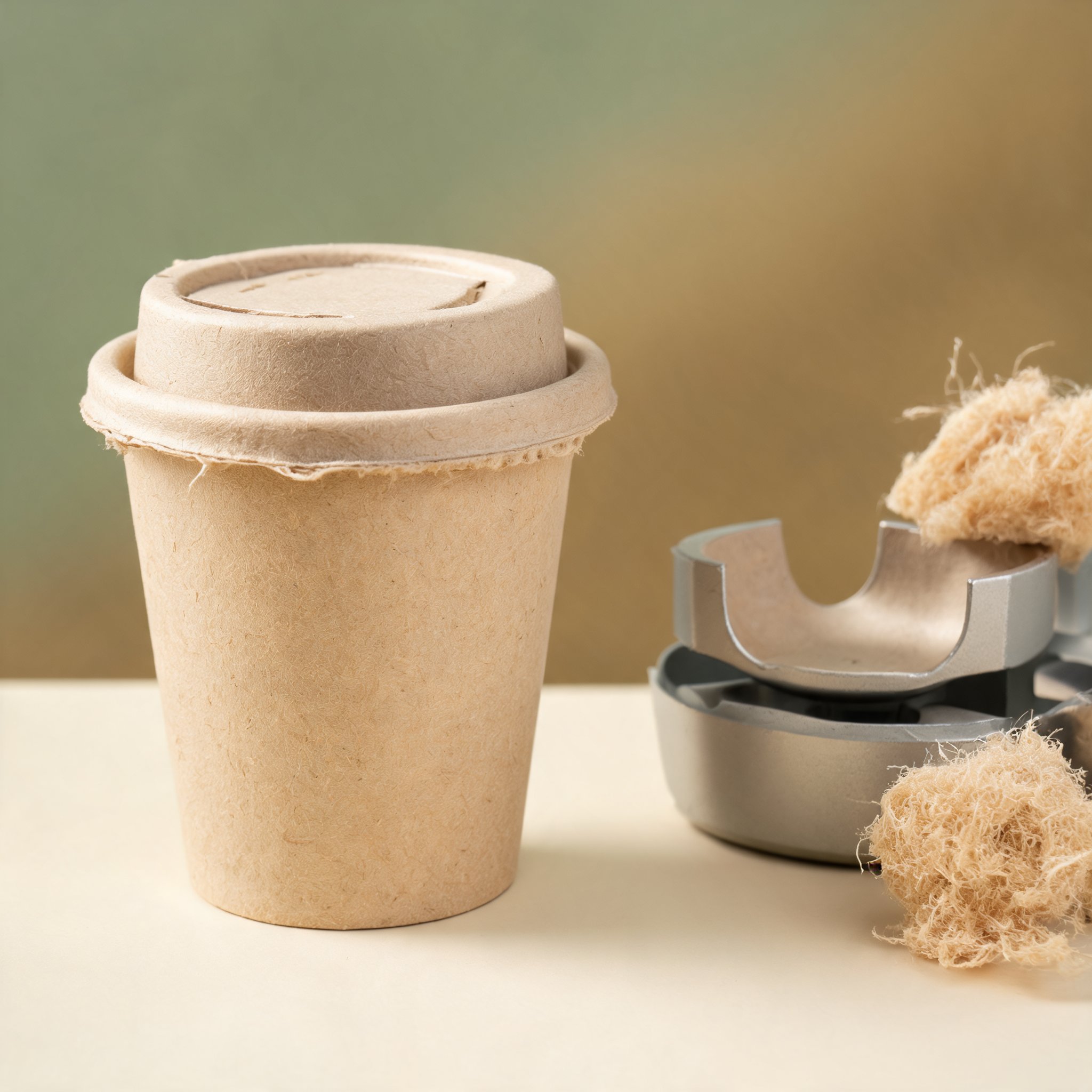
Yangi has extended its dry-forming platform for moulded fibre packaging with a new undercut feature, a capability the company says will help customers move fibre-based components into applications long held by plastic — beginning with coffee lids.
Undercut geometries are the precise recesses and lips that enable snap-fit connections and secure closures, creating a reliable mechanical fit between a lid and its container. Such details are routine in moulded plastic but are difficult to reproduce in moulded fibre, where material behaviour and tooling tolerances limit fine geometry.
Proven on a coffee lid
Yangi is presenting the capability through a coffee lid. The company reports a precision-engineered undercut that delivers a secure, consistent fit with a measured lid removal force of 6 N. In testing, the lid maintained a leak-tight seal and structural integrity across 10 simulated coffee pours over 10 minutes, including contact with hot beverages at 93°C.
“Achieving this level of precision in dry-molded fiber requires advanced tooling and forming expertise,” said Carlo Semeraro, head of Commercial Partnerships at Yangi. “The coffee lid demonstrates the performance we can deliver today, but the real opportunity is applying this functionality to a much wider range of packaging applications.”
Beyond lids
According to Yangi, the undercut technology is suitable for fitted closures in snack containers, takeaway containers, dessert and ice cream tubs, confectionery packaging, dry and ambient food containers, and packaging for personal care products, cosmetics and consumer goods.
The feature builds on Cellera, Yangi’s dry-forming platform, which runs on the company’s patented fibre formation system, FiberIQ. Unlike conventional wet moulding, the process forms fibre without a water-based forming step, an approach expected to lower water and energy demand in making renewable, fibre-based packaging.
In the coffee lid application, Cellera’s four-second production cycle is estimated to reach an output of 300 lids per minute. The platform is designed for high-volume, cost-competitive manufacturing, combining precise fibre distribution with advanced forming to deliver consistent quality and functional performance.
Industrial scale and summit showcase
Yangi says the announcement follows commissioning of its serial Cellera machine platform. Combined with the dry forming process, the company expects to reduce resource consumption and CO2 emissions by 70%-80% compared with conventional plastic alternatives.
“The challenge has never been simply to replace plastic with fibre,” said Yangi CEO Johann Kaiser. “It’s to make fibre perform at the level the market demands. Every new capability we develop reinforces fibre’s position as a competitive alternative to plastic by delivering the functionality, quality and industrial performance needed to drive the transition toward fibre-based packaging.”
Yangi will display the undercut feature alongside other elements of its dry-moulded fibre packaging range at the Sustainable Packaging Summit in Utrecht from 10 to 12 November 2026. Visitors can view the Cellera dry forming technology through an immersive VR experience at Stand 28 in the Networking Zone.
Separately, PulPac licensee Hébert Group has partnered with Andritz to scale up production of Dry Molded Fiber trays and lids, targeting water- and energy-efficient manufacturing from renewable or recycled fibres.